Cove and Visitt GTM and UI brief
*AI-generated recommendations for discussion. These are not Nick’s recommendations or approved JLL/PRISM guidance.
Assessment
Cove sells consolidation, a building experience that reflects the customer's brand, and an implementation partnership. Visitt sells operational improvement through AI, measurable service outcomes and connected workflows. Both pursue enterprise portfolios, offer tenant experiences, market AI and use expert-led demos. The difference is emphasis, not a clean category boundary. [G1] [G2]
Their product interfaces support these stories. Cove's evidence includes a branded tenant home, detailed operational forms and source-adjacent AI review. Visitt combines conventional operational lists with contextual AI prompts, reusable views and explicit automation rules. Neither interface is simply a chat window. [U1] [U3] [U4] [U5] [U6]
The findings distinguish observable tactics from inferred strategy. Public pages establish offers, references, channels and product presentation. They do not reveal customer-acquisition cost, sales-cycle length, contract value, conversion rates, expansion revenue or which channel produces the most wins.
GTM comparison
| Dimension | Cove | Visitt |
|---|---|---|
| Lead promise | Replace fragmented tools with a unified portfolio operating system and a committed implementation partner. [G1] | Use AI to improve operations, service and visibility across the portfolio. [G2] |
| Buyer coverage | Role, owner/operator and property-management-firm pages, with office, life-science, retail, industrial and medical sectors. [G1] | Broad owners/operators positioning, multiple asset examples and operational workflow pages. [G2] |
| Conversion | Demo and custom pricing; the pricing page advertises a proposal within a business day and included onboarding. [G3] | Demo form invites a call with an expert and frames the choice as switching from legacy software. [G7] |
| Relationship channels | Dedicated Cushman & Wakefield offer; the 2023 Presence alliance is supported by a customer-authored announcement. [G4] [G5] | A Related Ross account describes referral from another Related division; BGO is a large deployment reference, not evidence of a reseller agreement. [G9] [G12] |
| Customer proof | Recognizable buildings and operators, tool consolidation, tailored experience and support. [G6] | Prominent service metrics, migration examples, AI releases and enterprise deployments. [G8] [G16] [G19] |
| Expansion example | Longfellow introduced amenities, followed by PM and then work orders. [G6] | Related Ross combines tenant and operational services while retaining Related360; integrations allow coexistence. [G8] [G10] |
| Visible distribution | Customer stories, LinkedIn, education and BOMA presence. [G13] [G17] | Customer stories, LinkedIn, newsroom/AI launches, educational content and BOMA presence. [G14] [G16] [G18] |
These patterns support an inference of sales-led enterprise acquisition with substantial implementation support. Demo calls to action are not proof that every contract follows the same procurement process. Integration partners are not automatically referral, resale or co-selling partners.
Cove: how the motion works
Acquire through recognizable operating problems and trusted relationships. Role and sector pages let a buyer recognize their own building and responsibilities. The Cushman & Wakefield campaign goes further: it names the audience, offers preferred pricing, emphasizes included setup and support, and supplies relevant properties and customer testimony. This is concrete evidence of an account-specific acquisition tactic. The public material does not disclose its economics or exclusivity. [G1] [G4] [G5]
Lower the perceived cost of changing systems. The custom-pricing offer combines portfolio tailoring, a prompt proposal and included onboarding. The message treats implementation as part of the value proposition. The landing page's scale and undefined retention claims are vendor statements, not independently verified business metrics. [G3]
Enter through an immediately useful experience and expand the scope. Longfellow is the clearest example: amenities created an initial reason to use the app, followed by maintenance and work orders. Its story describes consolidation from eight to ten providers to one across roughly ten million square feet. This supports a phased-adoption pattern in that account; it does not establish the company's typical expansion rate. [G6]
Use AI to extend the existing portfolio relationship. Cove's June 2026 announcement describes introducing CoveAI to strategic clients before a broader rollout. The evidence supports customer involvement and expansion of functionality. Whether those releases create an upsell, improve retention or are included in existing subscriptions remains commercially unresolved. [G15]
PRISM response: bring an implementation plan and a relevant operator into the sale. Explain exactly how current workflows, integrations, tenant branding and local property exceptions will be handled. A broader feature list will not answer a buyer who values Cove's willingness to make the system fit their building.
Visitt: how the motion works
Acquire with operational outcomes and a visible AI story. Visitt repeatedly makes specific workflows marketable: work-order intelligence, translation, COI, reporting and billing. Its newsroom creates a sequence of launch, funding, award and customer-announcement moments. This is evidence of a communications strategy, not evidence that AI alone caused the customer outcomes. [G2] [G16]
Turn successful accounts into references and introductions. The vendor-authored Realcomm article says Related Ross was introduced by colleagues in Related's residential division. That is a specific referral path. The BGO announcement describes a rollout beginning in June 2026 across a planned 46 million square feet and more than 300 properties; it establishes enterprise reach, not that every property was already live. [G9] [G12]
Remove migration objections and permit coexistence. Related Ross's case emphasizes that Visitt took on data migration and operated alongside Related360. Its technology-partner page lists accounting, access, tenant experience, vendor and building systems. The inference is that Visitt can sell an operational center while preserving tools the buyer wants to keep. Validate each integration's actual scope rather than assuming every listed system is interchangeable. [G8] [G10]
Make proof easy for a sponsor to repeat. Carr's case foregrounds service-resolution metrics; Related Ross foregrounds adoption, satisfaction and engagement. These are concise stories a champion can share with an executive. They remain selected customer accounts, with deployment, training and process changes mixed into the result. [G19] [G8]
PRISM response: demonstrate a real operating sequence, make the result measurable and offer a credible migration path. Prepare references using the specific workflow being purchased. Show that PRISM's engineer and tenant journeys hold up under actual use, alongside the financial or portfolio outcome.
Product UI comparison
| Surface | Cove: observed pattern | Visitt: observed pattern | Implication for PRISM |
|---|---|---|---|
| Tenant entry | Historical training shows a branded home with service/amenity actions, people, events and building information. [U3] | Current Visitt+ guides show a branded home, requests, amenities, visitors, an inbox and property switching. Related Ross also documents coexistence with its existing experience platform. [U9] [G8] | Make the most frequent tenant action obvious and preserve the customer's identity. |
| Operational work | Detailed forms and a mobile note flow with saved text and AI rewriting. [U2] | Structured work-order lists, status, assignment, filters and reusable Views. [U6] | Match the screen to the role's next task and minimize re-entry. |
| AI presentation | Certificate evidence and editable extraction fields together; a visible rewriting control in mobile notes. [U1] [U2] | Related-request context next to the operational record; AI titles as fields in a list. [U4] [U6] | Put evidence and corrections beside the proposed action. |
| Automation | Documented assignment and routing controls cover issue types, groups and automatic assignments. [U8] | Explicit trigger, condition and assignment controls. [U5] | Make the reason for a routing or escalation action inspectable. |
| Compliance | A source document and extracted-field review panel. [U1] | Tenant profile groups tracking, requirements and certificate records. [U7] | Connect requirement, source, decision and outstanding owner. |
Cove's polished tenant experience should not be generalized to every administrative screen. Visitt's conversational positioning should not be mistaken for a product without forms, tables or configuration. Both preserve structured operational records because property teams need to sort, assign, review and report.
The selected images demonstrate interaction patterns, not comparative task speed. Help-center screenshots can be staged or dated; the Cove training frame and Visitt similarity illustration are historical. No authenticated product account was tested. Do not rank ease of use, accessibility, mobile reliability or AI accuracy from these pictures.
A new finding that narrows PRISM's financial wedge
Visitt's current billing page explicitly describes a completed-work charge-review inbox, an accounting queue with history and error handling, global/property charge-code libraries, tenant e-sign approvals and charges associated with amenities. These are stronger workflow claims than a simple integration logo. The current help guide also distinguishes verification from queuing a charge for synchronization and describes checking the accounting panel for failures. [G11] [U10]
PRISM should therefore prove whether it finds omitted billable events, resolves the buyer's exceptions with less effort and obtains reliable downstream accounting evidence. A billing queue or approval screen alone is not a differentiator. The earlier proposed revenue-assurance work remains a hypothesis, now with a more demanding competitor comparison.
What PRISM should change
- Create targeted acquisition offers. Give each segment a relevant customer, a concrete workflow and a clear implementation offer. A management-firm landing page should speak to that firm's buying context, as Cove's does; it must not imply an unverified commercial partnership.
- Package implementation as part of the outcome. Specify data readiness, the first usable workflow, engineer participation and the person responsible for integration problems. Show the buyer what happens after signature.
- Use a repeatable proof format. Show the input, operator action, AI assistance, correction and final business record. Follow with a named customer result using the same workflow.
- Make the product show the next action. A manager needs an accountable queue; an engineer needs a focused task; a reviewer needs evidence beside editable fields. AI assistance should remain visible within those tasks.
- Test adoption and correction paths. Include new users, incomplete data, wrong suggestions, changed property scope and lost connectivity in evaluation. These are more diagnostic than a polished happy-path demonstration.
The broader competitive opportunity is to make the market promise visible in the product and repeatable in deployment. PRISM can adopt these tactics without claiming that either competitor lacks enterprise capability, tenant experience or financial workflows.
Selected UI evidence
Seven representative images from the expanded application UI library. The flow atlas provides broader coverage across both products. These are source images, not recreated screens. Select an image to open its full resolution. Different workflows illustrate patterns; they are not a matched usability test.
Cove: the building as the entry point
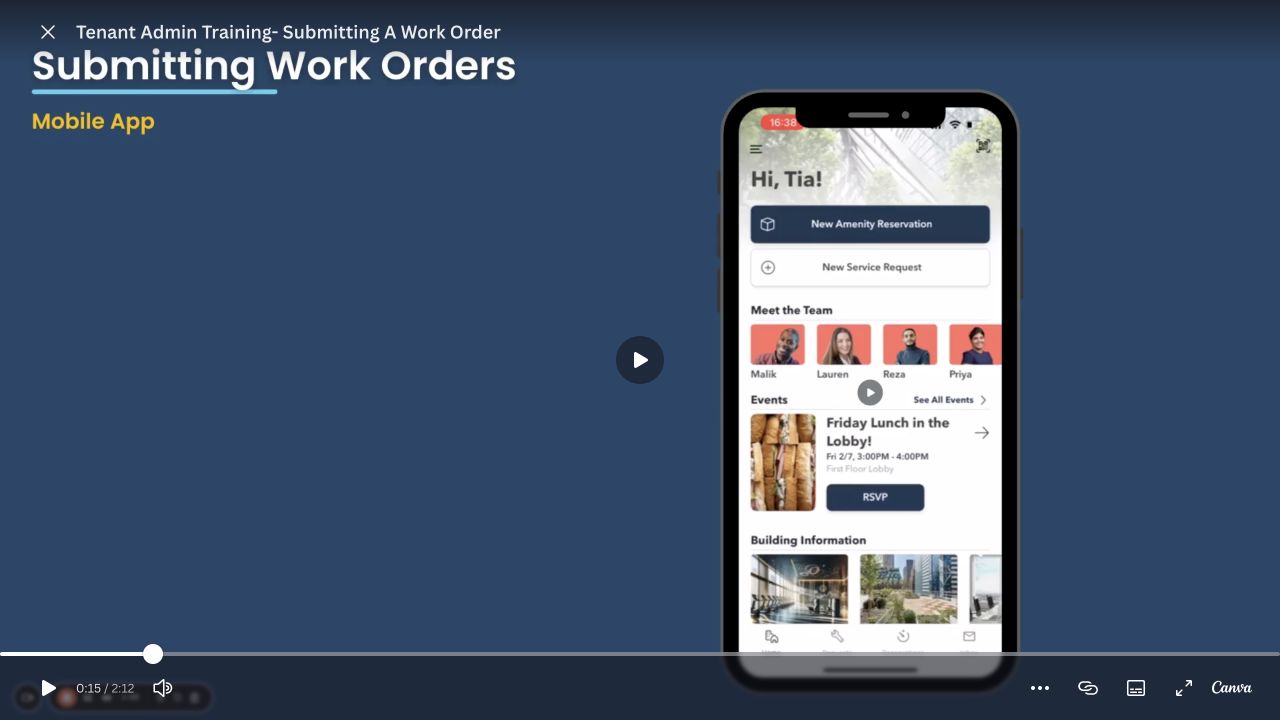
Training-video frame · Undated; linked by official training index · captured 2026-09-13. Original source
Cove: evidence beside a decision
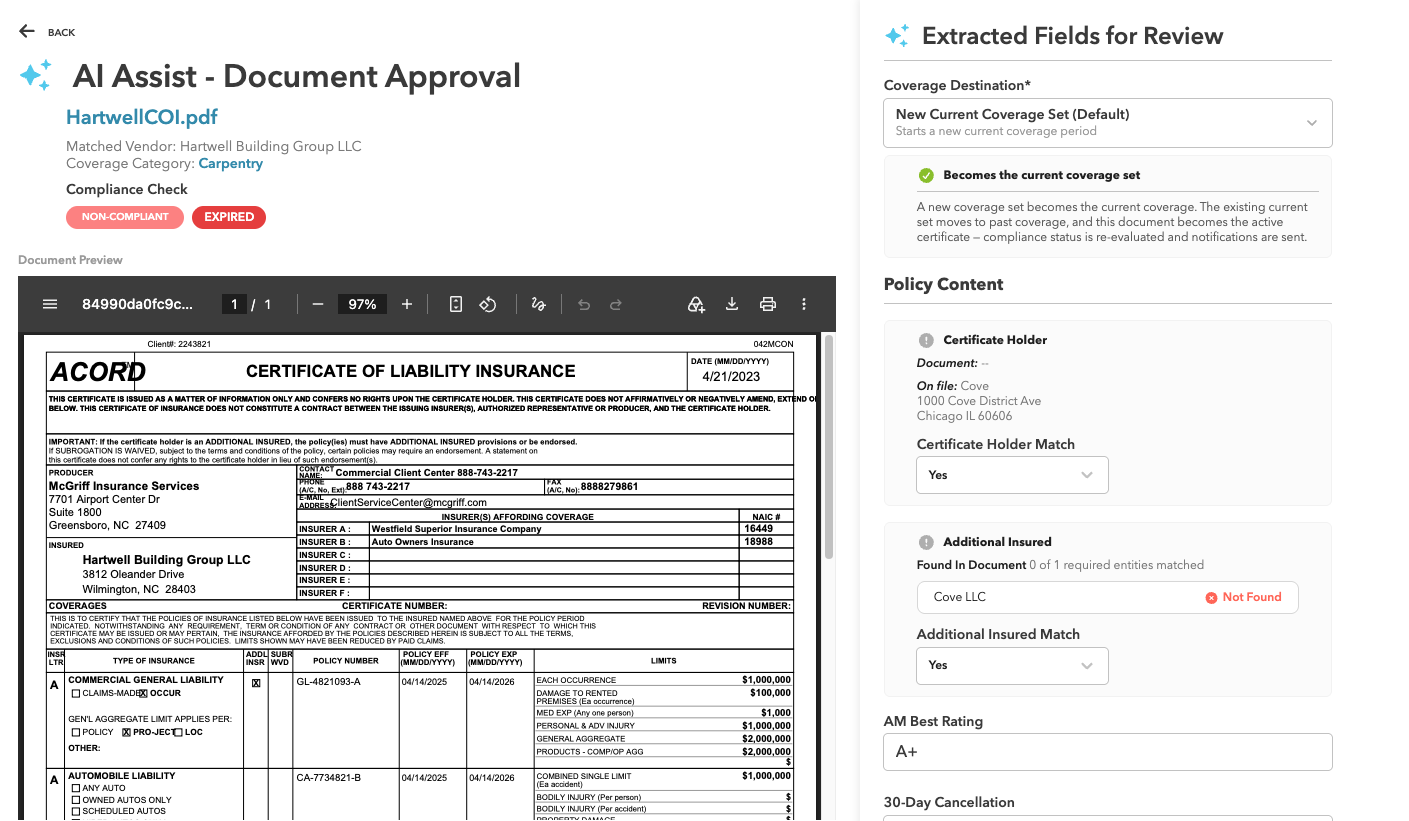
Help-center image · Current September 2026 revision · captured 2026-09-13. Original source
Cove: AI inside an ordinary field task
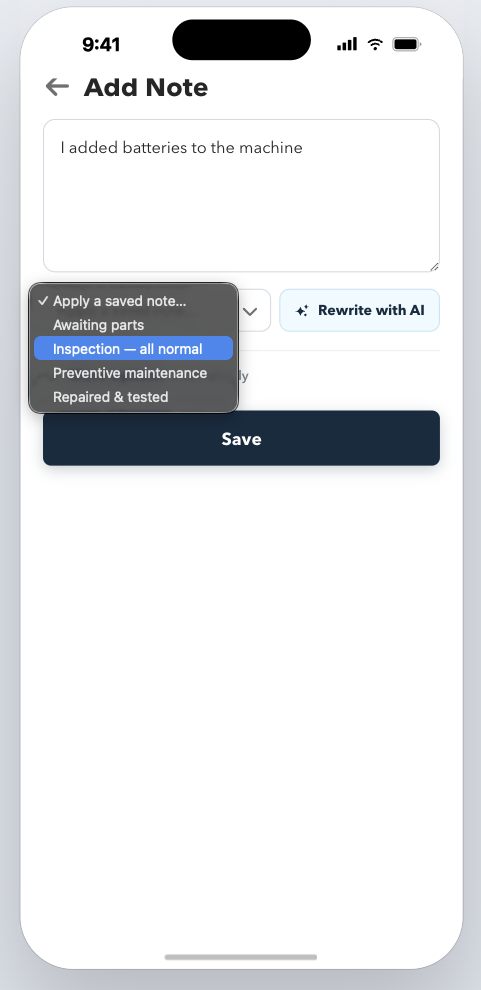
Help-center image · Displayed updated 1 month ago · captured 2026-09-13. Original source
Visitt: shared operational workspaces
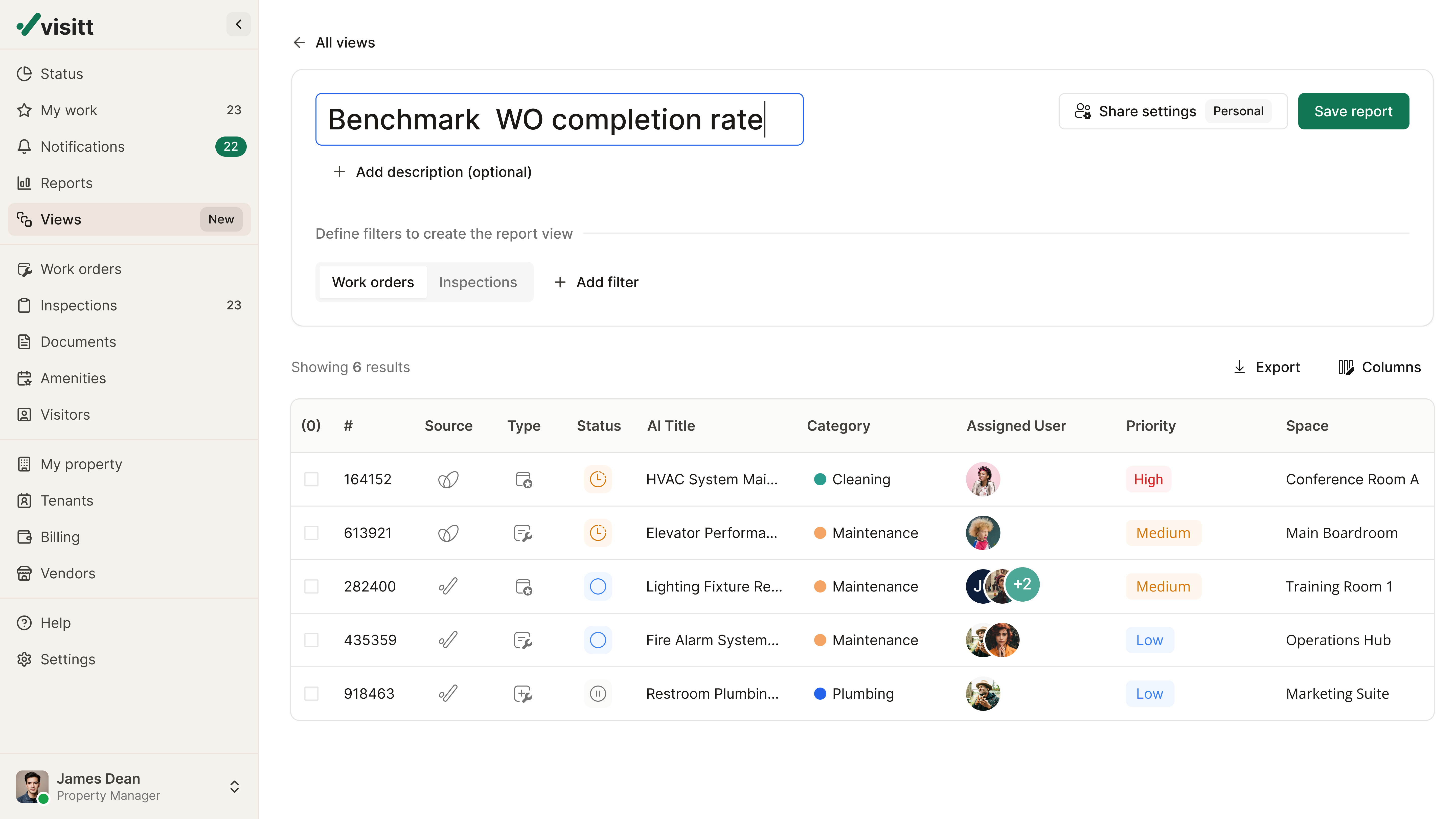
Help-center image · 2026-04-30 · captured 2026-09-13. Original source
Visitt: contextual intelligence
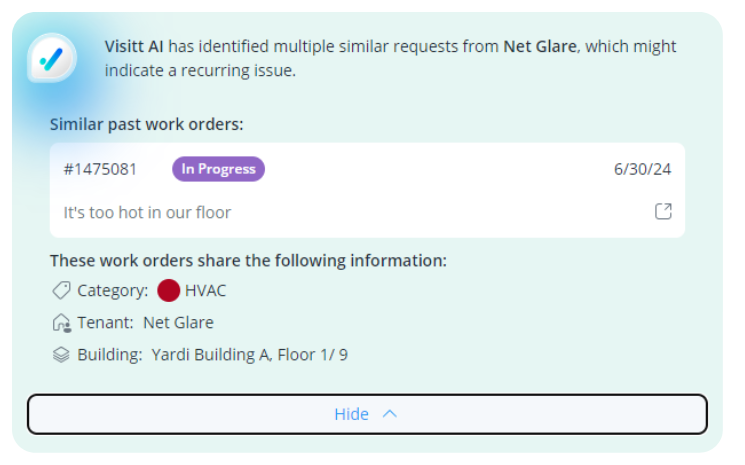
Help-center image · 2024-08-19 · captured 2026-09-13. Original source
Visitt: inspectable automation
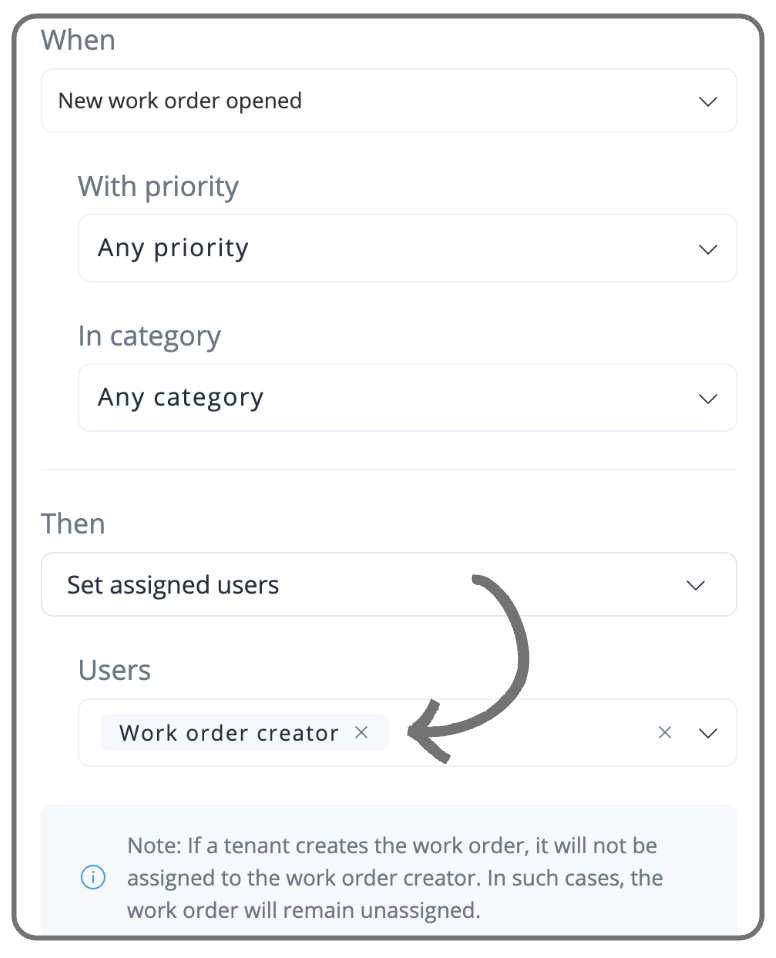
Help-center image · 2026-05-31 · captured 2026-09-13. Original source
Visitt: structured tenant compliance
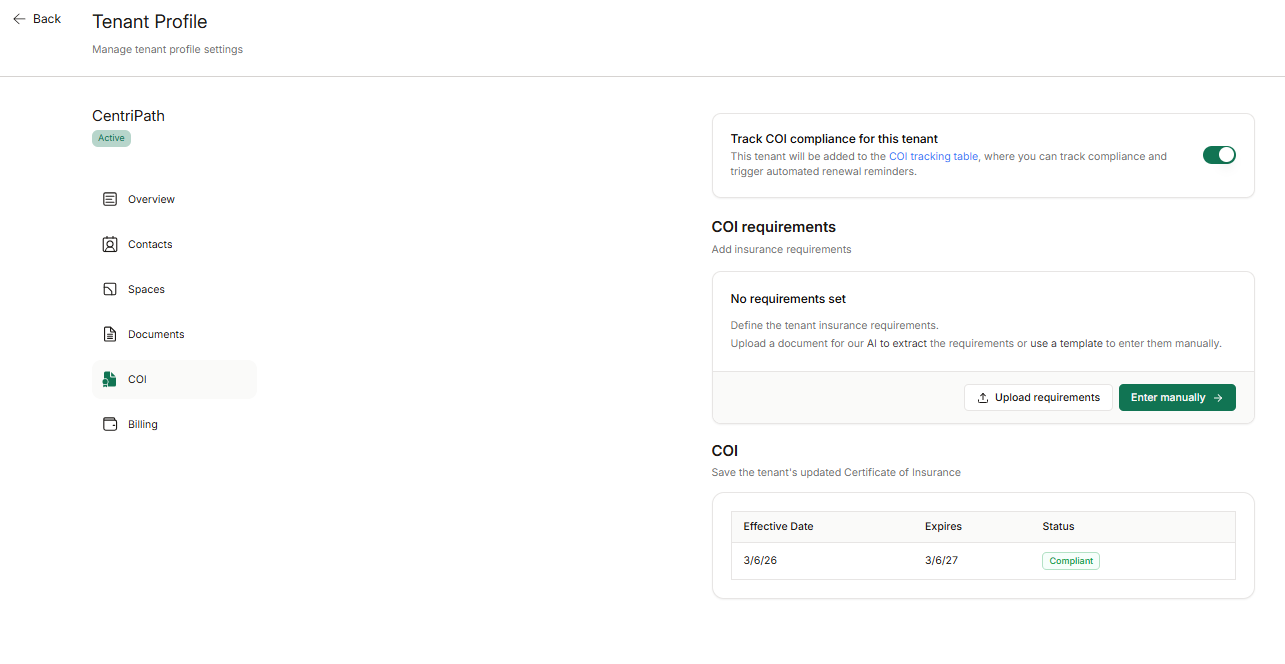
Help-center image · 2026-07-23 (displayed) · captured 2026-09-13. Original source
Sources
Accessed September 13, 2026. Vendor-authored content, observed UI and strategic inferences are distinguished in the analysis.
- [G1] Cove. Unified Commercial Property Management Software. Undated; current page.
Current 1B+ SF claim; integrations, pricing CTA and portfolio positioning.
- [G2] Visitt. CRE Property Management & Operations Software. Undated; current page.
- [G3] Cove. Get Pricing. Current page; accessed September 13, 2026.
Advertises a custom proposal in 24 hours / one business day and included onboarding. Scale and an undefined retention claim are vendor statements, not independently verified business results.
- [G4] Cove. Cushman & Wakefield campaign. Current page.
Dedicated audience offer; preferred pricing and deployment claims are vendor statements.
- [G5] Cushman & Wakefield. Presence creates adaptable, engaging workplaces. June 2023.
Strategic alliance evidence; no current exclusivity, reseller economics or referral volumes established.
- [G6] Cove. Customer Story: Longfellow Real Estate Partners. Undated; current page.
- [G7] Visitt. Demo request form. Current page.
Public expert-call funnel; no form submitted and no inferred sales response time.
- [G8] Visitt. Related Ross. Undated; current page.
- [G9] Realcomm / Sharon Tzvielli, Head of Marketing, Visitt. From Legacy Systems to AI Operations: Related Ross. December 18, 2025.
Vendor-authored trade publication article, retrieved through Exa. Reports referral from Related residential colleagues; not an independent case study.
- [G10] Visitt. CRE Technology Partners. Current page.
Public integration ecosystem; certification and workflow descriptions are vendor claims, not proof of co-selling contracts.
- [G11] Visitt. Tenant Billing Software. Current page.
Explicit review inbox, accounting queue, error handling, charge-code libraries and e-sign approval. Marketing page includes incomplete FAQ content; workflow performance was not tested.
- [G12] BGO. BGO Properties and Visitt announce national strategic partnership to power AI-driven operations. 2026-06-03.
Rollout began in June; announced scope is not evidence all sites completed deployment.
- [G13] BOMA International Conference & Expo. Cove exhibitor listing. 2026.
Organizer listing retrieved through Exa; presence does not establish lead generation or ROI.
- [G14] BOMA International Conference & Expo. Visitt exhibitor listing. 2026.
Organizer listing retrieved through Exa; presence does not establish lead generation or ROI.
- [G15] Cove / PR Newswire. Cove deepens AI capabilities. June 2, 2026.
Vendor announcement describes strategic-client introduction followed by wider rollout. Does not establish incremental subscription revenue.
- [G16] Visitt. Newsroom. Current page.
AI releases, customer deployments, funding and awards used as public narrative; not proof of conversion or model quality.
- [G17] Cove / LinkedIn. Cove company page. Current indexed feed.
- [G18] Visitt / LinkedIn. Visitt company page. Current indexed feed.
Current COI post mentions final human check; feed timing may vary by access.
- [G19] Visitt. Carr Properties. Undated; current page.
- [U1] Cove Knowledge Base. COI Extraction: AI Review. Current September 2026 revision.
Current browser text supersedes older indexed AI Review: COI Extraction content.
- [U2] Cove Knowledge Base / Andrea. Guide to Work Orders on Mobile. Displayed updated 1 month ago.
- [U3] Cove / Canva. Tenant Admin Training: Submitting a Work Order. Undated; linked by official training index.
Captured at 0:15, 0:35, 0:50, 1:20 and 1:52 of 2:12. Historical training UI.
- [U4] Visitt Help Center / Basman Abu Gazi. Visitt AI Capabilities. 2024-08-19.
Older similarity scope is same reporter; current marketing describes a broader scope.
- [U5] Visitt Help Center. How to Set Work Order Automations. 2026-05-31.
- [U6] Visitt Help Center / Zach Kahan. Create and Manage Views. 2026-04-30.
Saved filtered lists; distinct from natural-language analytics claims.
- [U7] Visitt Help Center / Zach Kahan. Set up and validate tenant COI requirements. 2026-07-23 (displayed).
Property defaults, tenant overrides, PDF extraction, revalidation choices and human confirmation. Current page inspected September 13, 2026; no live account test.
- [U8] Cove Help Center. Work Order Assignments and Routing. 2025-04-14T15:34:49Z.
Public operational documentation; screenshot dates and private deployment behavior may differ.
- [U9] Visitt Help Center. Getting Started with Visitt+: A Guide for Tenants. 2026-09-09T18:41:19Z.
Public operational documentation; screenshot dates and private deployment behavior may differ.
- [U10] Visitt Help Center. Billing Management. 2026-09-02T13:21:54Z.
Public operational documentation; screenshot dates and private deployment behavior may differ.